







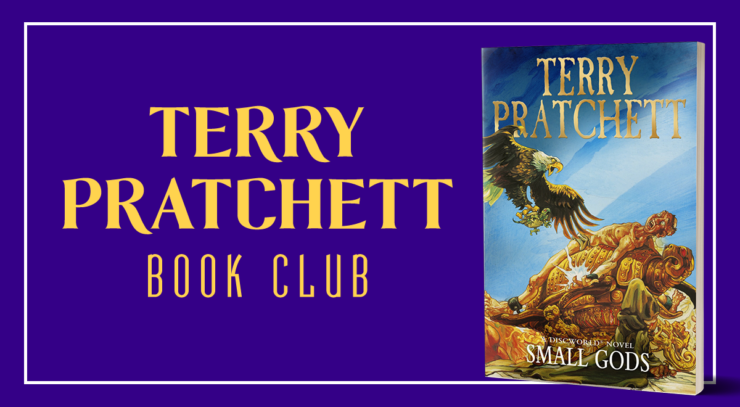
It’s time to eat some melon and have another chat with some Small Gods.
Summary
Fri’it arrives at his afterlife: He must set out across a desert with his beliefs. He thinks that he’s no longer sure what he believes, only to discover that isn’t true at all. Brutha travels with the caravan alongside Vorbis. He notes the soldiers traveling a mile behind on many camels, which Vorbis instructs him to forget. They board a boat to Ephebe, and Vorbis asks questions of the captain on deck, which leads to a conversation about porpoises. The captain makes the mistake of uttering a superstition that the souls of dead sailors become porpoises, and in order to prove he doesn’t believe such things, Vorbis insists that he kill one for them to eat. Om keeps urging Brutha to kill Vorbis, telling him about how the exquisitor laid him onto his back to roast. Brutha can’t think of any scripture that says cruelty to animals is prohibited. (There’s an aside about Koomi, a philosopher who wrote that gods had to be believed in to exist; the Omnian Church had him killed for this insistence.) The death of the porpoise is going to cause a storm, and Om is worried about dying in a shipwreck, so he prays to the Queen of Sea; she is mortified to have been summoned by a “small god.” Om insists that he has rights, even as a god with only one believer, and requests that she save the ship. The Queen of the Sea cannot refuse, but gets to name a price for such an act and promises that it will be high.
Buy the Book
Battle of the Linguist Mages
Sailors grab Brutha and intend to throw him overboard; the sea wants a life, and he’s the closest person they can find. Brutha asks to pray to his god beforehand and they give him ten seconds. In that space of time, the Sea Queen stops the storm around their ship and they sail out of it. They continue on the sea for days, the crew having a wary respect for Brutha after the incident. The captain sees a light in the desert and tells Brutha to inform Vorbis. Vorbis tells him to ask for the captain’s mirror and shine it toward the desert. Om dreams and remembers his beginnings, first speaking to a shepherd and gaining his first hundred followers in Ur-Gilash. The captain of the ship tells Brutha that despite what Om’s religion (and Vorbis) says, the world is flat, that he’s seen it. Om confirms this to Brutha, insisting that he never claimed to make the world. Brutha reports to Vorbis about how many flashes he saw from the desert and in what pattern.
They arrive at Ephebe and Brutha is startled to find that the Ephebians look like people rather than demons. He’s also startled at the statues of various gods, who Om can name and explain and also insists are just as real as he is. They all stop for a wet naked man named Legibus who runs into a shop to get a pot and string; he’s a philosopher, and they have the right of way in Ephebe. They are brought to a palace and blindfolded to get led through a labyrinth (but of course, Brutha remembers exactly how many paces it takes to get in, and in what directions). On the other side they meet Aristocrates, secretary to the Tyrant of Ephebe. They are given quarters and food, which Vorbis considers a taunt because this is a fast day. Om tells Brutha it isn’t and he can eat, then tells him to go out into the city and find a philosopher so he can find out about gods. They head into a bar where a group of them are fighting and ask the bartender, who insists they don’t come cheap, but mentions Didactylos as an option—he lives in a palace, so back they go. The next day, Brutha is called with Vorbis to meet the elected Tyrant of Ephebe, who is finishing the treaty that he intends them to sign, not discuss. Om finds Didactylos.
Vorbis insists that they pause the treaty negotiations until tomorrow. Brutha meets one of the slaves in the palace and asks about his life, then Vorbis gives Brutha permission to look anywhere in the palace as his eyes and ears. He goes to look for Om, who is busy helping Didactylos and his nephew Urn earn money by giving other palace dwellers something to bet on. Brutha asks Didactylos the questions Om is looking for answers to, and the philosopher takes him to the Library of Ephebe. Brutha sees things he’s never encountered before; art and images and maps and philosophy. Didactylos knows they’re blowing his mind a little, and tells him that he went to Omnia once, before he was blind, and saw people stoning a man in a pit—and notes that it’s the people who did the stoning that he found horrifying. Brutha is given a scroll on gods and hurries away, but Urn knows he saw Brutha in the tavern last night… which shouldn’t be possible because of the labyrinth.
Commentary
We’re at the beginning of an awakening for Brutha, as he’s being rapidly introduced to a world of new concepts and ideas. It’s described on the page as the awakening of a prophet, but this manner of awakening applies to all sorts of people on having their worldview widened. He’s got it from both sides as well, from both the god Om who keeps challenging the scripture he holds as gospel to the completely different way of life he finds in Ephebe.
There’s reference to many different figures of philosophy—Socrates, Archimedes, Descartes, Diogenes, the list goes on—and we’re also getting an introduction to the part politics will play in this story as we begin the treaty negotiations. But key to the middle of all this is the persistent disinformation that Brutha is slowly beginning to unravel.
The fact of that new awareness is easy to empathize with from Brutha’s standpoint, drawing comparisons between plenty of global religious sects who isolate their followers in order to ensure obedience. The gambit of these particular groups follow the rule that exposure to even the idea of heresy will promote heretical thought and perpetuate heresy, so the very idea of anything outside the community is demonized. This even extends to the point of other living beings; Brutha is shocked to find that the Ephebians are just normal people, who don’t seem particularly dangerous and certainly not devious forces of evil.
The pointed, though unspoken, key point is: Brutha is Om’s only true believer. We’re told as much, which means that all authorities that Brutha has been listening to—Vorbis in particular—are not believers at all. And this is where philosophy comes in and kinda crashes the party, right? Because from the standpoint of a faithful person, that is the most important aspect: The people who do these terrible things, who keep other people in the dark, they aren’t people of faith at all, even if they believe themselves to be. They are not representative of the religion, and they shouldn’t be counted as such. But from the standpoint of an atheist, that distinction isn’t likely to hold water: If the people in charge of an entire religion or religious sect are using it to hurt other people (and believe they are acting in interest of the faith), then the net result is horrible enough that maybe you should just abandon the whole thing.
The book is pointing to this disagreement without taking a side in it, just by its very structure. And we’re watching Brutha’s concept of the world unravel in realtime, particularly when he almost has a panic attack in the library over what people like Didactylos do, replacing the sureness of his upbringing with endless questions and ruminations on said questions:
And these bumbling old men spent their time kicking away the pillars of the world, and they’d nothing to replace them with but uncertainty. And they were proud of this?
His discomfort with that idea is countered by Didactylos telling the story of his experience watching Omnians stone a man to death. And what the old man found distressing about that scene wasn’t the man’s death, but rather that the people throwing those stones weren’t sure that person deserved death: What they were sure about was that they weren’t the ones in the pit being stoned. His point is that the people of Omnia are not good or fair, but afraid. So what is better? Fear or uncertainty? When are they the same thing, and when are they different?
My favorite thing about this section are all the little details that Brutha notes as “pointless” or “puzzling” that actually do have purposes. And again, they’re slipped into the narrative without commentary, just constant tweaks to how ignorance can warp your perception of what you see. For example, Brutha notes that there are beams in the library that are carved, and as far as he’s concerned, those beams have no purpose. But they’re either art, or a form of braille for Didactylos to find scrolls within the library, or possibly both. They do have a purpose; he just doesn’t have enough knowledge to perceive it.
Asides and little thoughts:
- Pratchett’s footnote about running if you wind up in the power of a person who says things like “Commence” or “Enter” makes me wonder what he would make of Captain Picard’s standard “Come,” or all the people in Starfleet who use “Enter” when people show up at their doors. I’m guessing he’d still stand by the statement, of course. It is pretty damned unnerving.
- The Ephebian statues are all described as white stone, but to be more accurate to historical Greeks, they should be painted! To my understanding, this knowledge didn’t become part of discourse available to the general public until the 1980s or ‘90s, and has really only gained ground in the past twenty-ish years or so. Plenty of folks never learn about it at all, so it’s always a good reminder to add into any conversation about classical statuary.
- I really do appreciate the shout out to the chain letter as a fear tactic: The Tyrant talks about Omnian tactics as a letter that chains men’s minds, then referring to it as a “chain letter,” which is a reference to the sort of letters, emails, and now social media messages that we’re all liable to be familiar with. “Send this ten people in the next hour and something terrible/wonderful will happen!” The point being that you’re either threatened to act with the possibility of trauma, or told that a lack of action means you pass up on something good. Again: fear or uncertainty?
- Of course, the Library of Ephebe is a stand-in for the Library of Alexandria, which every book/history nerd will be sad about unto the end of time.
- The bit where Om says that he doesn’t choose people, they choose themselves, has a ring of Good Omens in it. The thought is very similar to what Crowley is constantly saying: All of this is people, they create the true good and bad, the Heaven and Hell.
Pratchettisms:
You couldn’t put off the inevitable. Because sooner or later, you reached the place when the inevitable just went and waited.
You couldn’t think about how you thought. It was like opening a box with the crowbar that was inside.
“I never chose anyone,” said Om. “They chose themselves.”
For sheep are stupid, and have to be driven. But goats are intelligent, and need to be led.
And then five years later they elected another one just like him, and really it was amazing how intelligent people kept on making the same mistakes.
Next week we’ll read up to:
“Honey,” he said.
“What?”

Point that non-British readers are likely to miss – “Didactylos” means “two-fingered”. This is a reference to the two-fingered salute, i.e. making a v-sign with your first two figures and showing it to someone with the back of your hand facing them (a reverse “peace sign”).
While origin stories about English bowmen at Agincourt are purely fictional, it’s an insulting gesture, often given to those in authority, and tells the British reader everything you need to know about Didactylos before we ever actually meet the man.
The first sentence is plausible; the second is highly debatable. The people who do terrible things may or may not be representative of religion as a whole, but there are subsets (in their view, the only true sets) that they are entirely representative of. For an extreme (in one direction) case, think of the tiny group that has been going to military funerals shouting that the death happened because the US tolerates homosexuals. (I’m not mentioning the current elephant to avoid getting sidetracked.) There are divisions of religion that tolerate uncertainty, and divisions that don’t; ISTM that a theme running through most of Pratchett’s books is that the person who is absolutely certain of their rightness is most likely to be dangerously wrong. (Consider this as an extreme case of the line attributed to Will Rogers.)
I would also argue, having gone through an atheist phase, that you are reducing atheism to a single and probably uncommon dimension; what atheists think about religion can vary as much what religions think about each other.
other Pratchettisms:
Fri’it’s desert to plod over is like the version of the Egyptian afterlife described in one of Lovegrove’s ancient-gods-in-modern-times novels; if that’s accurate (for ordinary people), it’s interesting to put here rather than in Pyramids.
It’s amusing that the sergeant who abets Vorbis is named after a form of religious corruption; simony is the sale of church offices, roles, or artifacts.
Thoughts.
The idea of isolating harks back to the medieval church’s cloistered monks and nuns, some of whom also adopted vows of silence. Later many of these rules were relaxed.
As Chip137 points out, atheists come in many varieties as well. I am a science based atheist in that I deny that a supernatural being can affect the natural world. I don’t object to churches worshiping gods, I object to the doctrines they follow. In a few more weeks we can discuss this regarding Om and Brutha.
To be fair to religion in general. The fear versus uncertainty is an Omnian choice. Many religions add positives like miracles and the afterlife.
Thank you Muswell for the clarification. I knew Didactylos meant two-fingered but I never associated it with the up yours gesture.
Count meas another who never made the Didactylos connection.
I live the sheep/goats quote and the “bumbling old men” paragraph quoted in the commentary. An atheist myself (of the “no-god-shaped-hole-in-the-universe” type) I really enjoy reading Brutha’s experiences in Ephebe, with him learning so much about the wider world and his own religion. I love even more that he still manages to keep his faith and integrity intact because he can separate his belief from the actions of those around him.
Is this the first example of the crowbar inside the box? We will see it again.
“a blind watchmaker” is not exactly a Pratchettism – it’s a joke he seems to have stolen from the title of Richard Dawkins’ 1986 book on evolution/ against “intelligent design”, The Blind Watchmaker. Or at any rate, it’s a reference, not an original witticism.
@7: Watches and Watchmakers
The blind watchmaker is not a joke or quip but a serious teleological argument by William Paley from around 1800. Note that it is not an argument for christianity, just for a designer or watchmaker. Dawkins, who respected Paley’s work, felt it was one of the strongest arguments for intelligent design and wrote his book to disprove the theory which was being used to get around bans on christian creationism being taught in schools.
Epheeeeeebe, how I love thee and thy philosophers.
I especially like the conversation that begins with “We think, therefore we am.”
I consider Didactylos the C.M.O.T. Dibbler of Ephebian philosophers, and particularly appreciate him because I’m legally blind. (I’m told Ratonasticthenes in The Science of Discworld is another Dibbler-counterpart in Ephebe, but I don’t remember anything about him.)
I snorted at “ambisinister – incompetent with both hands.”
Yeah the sea “gives rise to dangerous ideas.” Like the desire to go under the sea, which is hazardous to my physical health when I do it and bad for my mental health when I can’t.
The sea is always powerful. So many people believe in it. But it seldom answers prayers. TRUTH. I worship oceans and other waterways, if I could be said to worship anything, yet I remain mostly terrestrial. *points at username*
Pratchettisms:
Another pause, a tar pit of silence ready to snare the mastodons of unthinking comment.
Gods rose and fell like bits of onion in a boiling soup.
“If you spend your whole time thinking about the universe, you tend to forget the less important bits of it. Like your pants.”
Humans! They lived in a world where the grass continued to be green and the sun rose every day and flowers regularly turned into fruit and what impressed them? Weeping statues. And wine made out of water. […] As if the turning of sunlight into wine by means of vines and grapes and time and enzyme wasn’t a thousand times more impressive and happened all the time.
“We are here and it is now. The way I see it, everything after that tends towards guesswork.”
Call-back:
We had fun with Xeno and Ibid in Pyramids, which is supposed to have been set a century after this book. Reader theories about this pin in on either the pyramids or the History Monks.
Looking ahead:
Ephebian philosophers go around musing about the universe, getting wild ideas, and occasionally inventing very lethal devices without considering the consequences. Basically, they’re all prototypes to Leonard of Quirm. Put another way, Ephebe is a nation of free-range Leonards. Unfortunately, they will henceforth be entirely replaced by Leonard in the Discworld narrative. Which is unfortunate, because Leonard is a delight but can’t provide hilarious dialogue like a group of philosophers.
“You are a walking book, Brutha.”
“FedEcks the Messenger of the Gods” first gets mentioned here, and will eventually get involved with the Ankh-Morpork Postal Service.
Didactylos won’t be the last Discworld character to write something that unintentionally fuels a revolution.
” If the people in charge of an entire religion or religious sect are using it to hurt other people (and believe they are acting in interest of the faith), then the net result is horrible enough that maybe you should just abandon the whole thing”
Any institution that purports to promote a philosophy, be it a theology or an ideology, is in danger of falling into the hands of the corrupt over a long enough period of time. If you are going to reject philosophy based on the corruption of its institutions than none will survive the test over the long run, and where does that get you?
There is a world of difference in truly believing in a god and conflating a god with institution of the worship of said god. Vorbis and his parishioners don’t really believe in Om because they believe in the Omnian Church. And it makes sense: they don’t have to test their faith when their Church gives them proof of what happens to heretics and non-believers in this world. A more interesting question is does Vorbis have faith if faith requires a believe without any proof?
@8: ISTM that Paley is responsible for the (not-blind) watchmaker argument that something so complex as life must have been designed; “blind” was added by Dawkins in a counter-argument.
@13: You’re right, I didn’t make that clear.
@9: “ambisinister – incompetent with both hands.” For those who didn’t get the joke. Dexter was Latin for right and sinister for left and the right hand was thought competent while the left hand was not.
Further thoughts.
I loved the philosophers betting on Om’s ability to draw shapes (that’s not a square, it’s a parallelogram) and especially Urm’s complaining that Om not knowing the difference between decagons (10-sided) and dodecagons (12-sided). As Brutha explains they’ll now be able to get even better odds for tomorrow’s betting.
I also loved the idea that Discworld’s Athena is stuck with a penguin instead of an owl because of the incompetence of the sculptor. But it points out that images shape beliefs. Because of their depictions in art, most christians think of Jesus as a white European.
@11:
When an institution goes rotten, IME its philosophy (or at least the expression of that philosophy) also goes south; sometimes the only approach is to tear down the institution and what it now espouses, and try to recover what once motivated it — then re-examine that philosophy in the light of however much time has passed. I think you will find many people espouse many of the principles that are ascribed to Yeshua bin Yussuf without accepting most of what accreted to those principles — particularly after those principles had passed through Saul the apostate, Roman hiearchicalism, and the Council of Nicea, not to mention all of the power politics since then.
I don’t know how far into religious mythology Pratchett was intending to dig with this, but it occurs to me that he may have been riffing off a variety of sheep/goat comparisons that commonly favor the drivable over the intelligent, e.g. we have “scapegoat” rather than “scapesheep”. I haven’t found a literal (rather than poetic) translation of the early-medieval acrostic text “Apparebit Repentina Dies”(*) about the Xian Day of Judgement, in which the elect are separated from the “fetid goats”; one wonders which assorted religious figures first thought of comparing people to sheep and how much this was a deliberate attempt to encourage people to follow without thinking.
(*) I know it from Hindemith’s setting for chorus and brass, but I last did it back when my chorus still loaned scores instead of requiring us to buy our own.
@16: The sheep thing dates at least back to the Gospel of John, who first uses the term “lamb of god” and Revelation uses a lot of lamb, shepherd, and sheep terminology.
I can’t find a translation of Hindemith but I did find a translation of Christ, an Old English poem attributed to Cynewulf.
“The King shall sit on the throne of his majesty, surrounded by trembling hosts of angels. The elect shall be gathered at the right, and the wicked, like fetid goats, at the left.
The righteous shall be welcomed to the kingdom, because of their pity for the poor. The wicked shall be cast into hell, because of their uncharitableness.”
As a devoted follower of Jesus and an avid reader of the Pauline Epistles I loved how Ephebe feels much like how I imagine Ephesus to have felt like in the Acts of the Apostles. I can imagine the philosophers of Ephebe deciding to stone St. Paul much as the makers of idols did because he blasphemed Diana, outside the very Temple of Diana one of the Seven Wonders of the Ancient World.
Also I think it is highly likely the Library at Ephebe is not a stand in for the Library at Alexandria, but rather the great Celsus Library that was built as a monument to Gaius Julius Celsus Polemaeanus, the Governor of that province in Asia Minor, in 117 A.D. It contained over 15,000 scrolls and was considered one of the most beautiful buildings in Ephesus.
@18: Ephesus was certainly one of the hubs of the early christian church but it was famed, at that time, for commerce and not philosophy. Paul was accused of threatening the livelihood of the silversmiths who made silver statues of Diana (Artemis) for sale. As Acts says the equivalent of the court found him not guilty of blasphemy because he was just advocating for yet another new god, something the Greeks and Romans were used to.
Looking into it, you might be on more solid ground with the Celsus Library (built well after Pauline times). It was the only Roman library that we have a floorplan for and it was dedicated to Athena so Terry may have utilized it for his descriptions.
It’s worth pointing out that the burning of the Library of Alexandria is a myth. Oh fires did damage parts of the collection from time to time, ancient cities were very flammable, but no single devestating fire destroyed the institution in one blow. The Library seems to have faded away over the centuries, losing out to other centers of learning, it’s collection dispersed rather than destroyed. Very undramatic.
@20: The christians definitely got a bad rap for this.
Musing on the intersections of the bible and Discworld, it’s interesting to note that the biblical description of the world in Genesis – a flat disc surrounded by a firmament in which the sun and moon are embedded – is very similar to Discworld.
ISTR that we’re shown early on (in The Light Fantastic?) that A’tuin is moving through space — which means that the sun and moon can’t be embedded, or they’d be left behind. My reading of The Last Hero is that the moon is confirmed to orbit freely, but that’s only a hint.
The attributed-to-Cynewulf is much the same theme (and possibly a similar period) as the acrostic I cited, but I’m interested to read that the sheep comparison goes much further back. Interesting that it should be used in a religion that was revolting against an established priesthood.
The insulting two-fingered gesture is equally likely to have come from holding two fingers behind someone’s head to indicate that they have horns, that is, they have been cuckolded by their marital partner. It is shown that way in certain 18th century caricatures.
Both the moon and the sun of the Discworld are very small compared to the Disc itself, and orbit around it in what seems to be a very complex pattern (night is caused by the sun going underneath the Disc, and presumably seasons are caused by the sun being closer or more distant to various regions). I think this is described already at the start of The Colour of Magic.